
Politics
Iran’s collapse is no longer theoretical.
Iran Is Breaking Global Silence
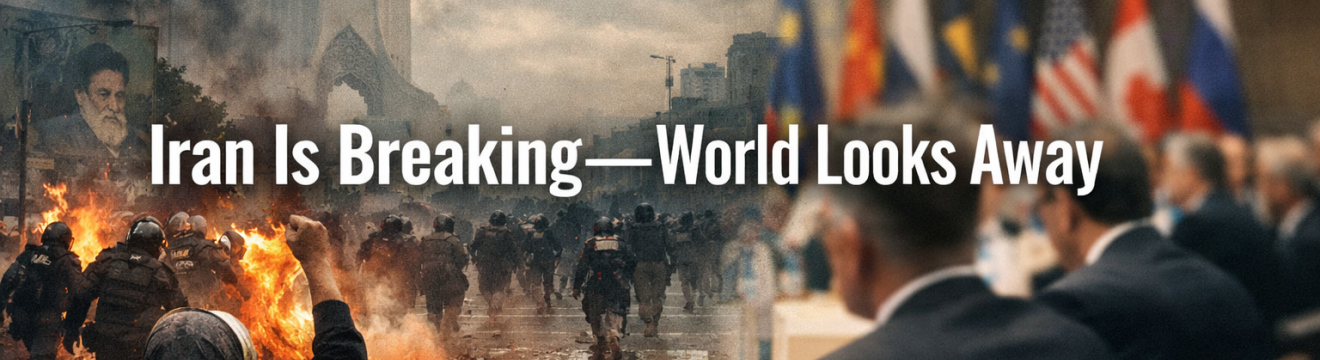
Iran is Breaking (Source: Saman Hajibabaei )
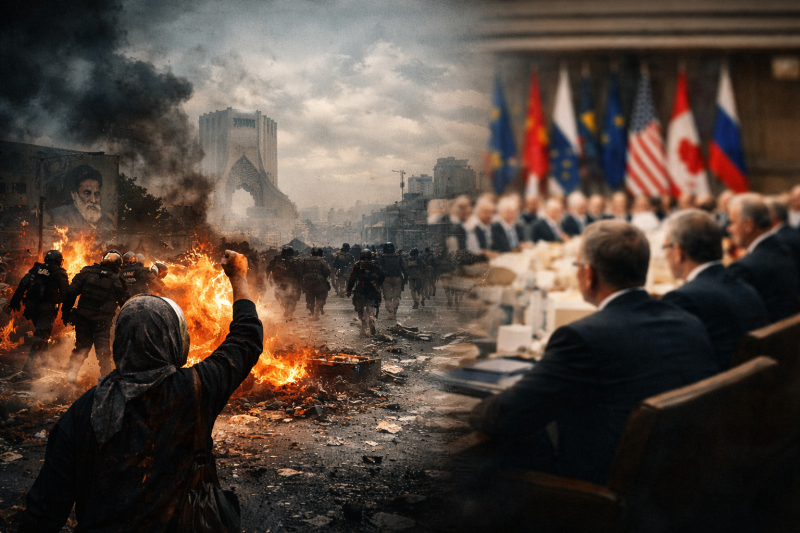
Between Flames and Silence
(Source: Saman Hajibabaei )
(Source: Saman Hajibabaei )
Yet Iran’s crisis is not fundamentally economic. The economy is only the mirror; the fracture runs deeper.
The Islamic Republic shows no intention of reform, retreat, or reconciliation. It does not slow down, recalibrate, or seek accommodation with the world.
Confrontation is not an accident of policy; it is a deliberate choice. The regime neither attempts to purchase legitimacy abroad nor makes even minimal efforts to rebuild the broken bond with its own society. Instead, it intensifies the familiar instruments of survival employed by exhausted power structures.
Executions of critics often innocent are increasing, serving as naked demonstrations of coercion rather than justice.
The regime amplifies a theatrical, artificial nationalism so hollow that it actively repels genuine nationalists.
It refuses to abandon regional militarism, treating external conflict as a substitute for internal collapse.
It persists in supporting militant and terrorist networks, fully aware that this path deepens isolation, tightens sanctions, and transfers the cost directly onto an already impoverished population.
None of this is random. These are not policy miscalculations; they are the behavioral patterns of a system in decline. History is unambiguous on this point: when a ruling order simultaneously abandons internal legitimacy, prefers hostility over diplomacy, replaces politics with violence, and sacrifices economic survival to ideology, it is no longer facing a temporary crisis. It is entering the terminal phase of a historical cycle.
It refuses to abandon regional militarism, treating external conflict as a substitute for internal collapse.
It persists in supporting militant and terrorist networks, fully aware that this path deepens isolation, tightens sanctions, and transfers the cost directly onto an already impoverished population.
None of this is random. These are not policy miscalculations; they are the behavioral patterns of a system in decline. History is unambiguous on this point: when a ruling order simultaneously abandons internal legitimacy, prefers hostility over diplomacy, replaces politics with violence, and sacrifices economic survival to ideology, it is no longer facing a temporary crisis. It is entering the terminal phase of a historical cycle.
The question, therefore, is no longer whether the Islamic Republic is in decay. That reality is already established.
The real question the only one that remains unresolved is this: how will this collapse unfold, at what cost, and on whose shoulders will the burden ultimately fall?
Iran is no longer merely under strain; it is experiencing economic, psychological, and security collapse simultaneously.
And yet, the streets are quiet. The question that confronts outside observers particularly in Europe and the United States is deceptively simple: if a society is this broken, why is it not in permanent revolt?
The real question the only one that remains unresolved is this: how will this collapse unfold, at what cost, and on whose shoulders will the burden ultimately fall?
Iran is no longer merely under strain; it is experiencing economic, psychological, and security collapse simultaneously.
And yet, the streets are quiet. The question that confronts outside observers particularly in Europe and the United States is deceptively simple: if a society is this broken, why is it not in permanent revolt?
The answer is not apathy. It is calculation.
Iranian society, especially its younger generation, has already demonstrated repeatedly and unmistakably that it rejects this system in its entirety. Whether or not young Iranians use the language of political theory, their instincts are unmistakably liberal, secular, and democratic.They demand dignity, personal freedom, truth, and a normal life connected to the world. They have shown this not once, but over and over again.
In 2016, 2019, and 2022, the Iranian public rose despite overwhelming odds. Across these waves of protest, an estimated 3,000 people were killed and thousands more imprisoned, tortured, or permanently scarred.
These uprisings answered one question definitively: Iranians are not afraid of revolution. They are willing to confront power directly.
They have already paid the price that fear demands.
What was proven to Iranians themselves and to the world is that this society does not want reform, compromise, or cosmetic change. It wants a complete break with a decaying and violent system. The slogans were unambiguous. The red lines were crossed.
The illusion of consent was shattered.
The illusion of consent was shattered.
So why are they not back in the streets now?
Because another lesson was learned one far more bitter.Iranians learned that when they stand up and are crushed with extraordinary brutality, no meaningful international consequence follows.
They learned that mass killings, public executions, and systematic repression trigger statements, not deterrence.
They learned that isolation, sanctions, and diplomatic rituals punish society far more than power.
They learned that truth does not automatically mobilize the so-called international community.
For ordinary Iranians, the equation is now brutally clear:
to protest again means to face a violent, blood-soaked crackdown without protection, without leverage, and without interruption from global actors who claim to defend human rights but carefully avoid confrontation.
This is not fear. This is rational restraint.
A society exhausted by isolation, sanctions, and institutionalized lying does not lack courage it lacks guarantees. It understands that courage alone is not enough when the regime’s violence is unconditional and the world’s response is conditional, delayed, or symbolic.What Western audiences must understand is this: silence in Iran today is not consent, and it is not defeat.
It is the pause of a population that has already proven its will, assessed the cost, and recognized that the current international order has left them alone with their executioners.
The streets are quiet not because the demand for change has faded, but because the world has taught Iranians that resistance, when unsupported, becomes a massacre not a movement.
And until that equation changes, the most dangerous illusion is to mistake calm for stability.
Everything Was Documented. Everything Was Condemned. And Then Nothing Happened.
The files exist.The reports are written.
The resolutions are passed.
The statements are archived.
But accountability? Deterrence? Consequences?
None.
For years, international human rights institutions have claimed to be “addressing” the Islamic Republic of Iran.
Every year brings new resolutions, new reports, new expressions of concern. Executions, mass arrests, torture, repression of women, killing of protesters everything is meticulously documented, footnoted, and translated.
And the Islamic Republic does not even pretend to care.
Why should it?
Toothless Resolutions, Predictable Outcomes
The UN General Assembly has adopted annual resolutions condemning Iran’s human rights record for decades. The most recent vote, in December 2025, followed the same ritual: formal language, moral condemnation, numerical tallies.And the day after?
Executions continued.
Repression intensified.
No official responded.
Because these resolutions are non-binding, everyone involved understands the reality:
a condemnation without consequences is not pressure—it is paperwork.
Resolutions that carry no cost are not warnings; they are background noise.
Fact-Finding Without Consequences
In November 2022, the UN Human Rights Council established an Independent International Fact-Finding Mission on Iran. Its mandate was serious. Its findings were damning. Testimonies, videos, forensic evidence—proof beyond dispute.And yet:
• Iran refused cooperation
• No officials were subpoenaed
• No travel bans were imposed
• No arrest warrants were issued
Truth was collected. Power remained untouched.
The regime learned the lesson quickly: documentation is survivable.
The Special Rapporteur: A Voice Without Leverage
The UN Special Rapporteur on Iran has repeatedly warned of crimes that may amount to crimes against humanity. The language is clear. The implications are grave.But the Special Rapporteur has no prosecutorial power.
No enforcement mechanism.
No authority beyond reporting.
He speaks.
The regime listens—or doesn’t.
Nothing changes.
Refer Iran to the ICC”—The Sentence Everyone Avoids
Human rights organizations have repeatedly called for Iran’s case to be referred to the International Criminal Court. The response from states has been diplomatic silence.Why? Because referral requires political will.
Political will requires confrontation.
Confrontation carries cost.
So the request circulates endlessly—supported by NGOs, ignored by governments.
Everyone agrees in theory.
No one acts in practice.
Europe’s Favorite Phrase: “Deeply Concerned”
The European Parliament has passed multiple resolutions condemning Iran. The language is polished. The outrage carefully calibrated.But:
• No universal travel bans on senior officials
• No arrests during foreign travel
• No judicial pursuit under universal jurisdiction
Concern, it turns out, is cheap.
Enforcement is expensive.
Moral Condemnation Without Power
When the Nobel Peace Prize Committee condemned the violent treatment of Narges Mohammadi, headlines followed. Statements were issued. Moral clarity was displayed.And the Islamic Republic carried on unchanged.
Ethics without enforcement are not justice.
They are performance.
The Question No One Wants to Answer
With all these reports,all these resolutions,
all these “deep concerns”—
why was not a single senior Iranian official globally banned from travel?
Why was not one arrested while abroad?
Why did this regime never once feel punished for its crimes?
The answer is simple and uncomfortable:
The international system replaced action with documentation.
Words with safety.
Justice with procedure.
And Iranians have understood this perfectly.
They have learned that “international condemnation” does not stop bullets.
That reports do not block gallows.
That statements do not interrupt massacres.
Until human rights violations carry real, personal, unavoidable consequences for those in power, every new declaration is merely an updated version of the same old silence.
And mistaking this silence for diplomacy is the most dangerous illusion of all.
Then be honest. Stop pretending
If you claim to stand for human rights—if you issue statements that perform empathy,
if you circulate reports that describe human pain in perfect institutional language
then say it plainly:
Human rights, as practiced today, are selective.
They are conditional.
They are financially and politically curated.
And when they are inconvenient, they are reduced to theater.
Enough with slogans.
If these institutions were what they claim to be, they would have acted by now.
If they were serious, they would have created real pathways for people under brutal rule.
If they were honest, they would have done the bare minimum:
they would have told the people of Iran
If you go to the streets, the least we will do is impose real punishment on those who rule you not symbolic condemnation, not statements, but consequences.
They did not.
Instead, they taught an entire society a devastating lesson:
that courage without protection leads to massacre,
that truth without power is disposable,
that resistance without international cost for perpetrators is suicidal.
So say it openly.
Say that “human rights” has become an institution of preference,
funded, filtered, and activated according to interest
occasionally uncomfortable, publicly concerned,
but ultimately safe, managed, and non confrontational.
Because if it were anything else,
it would not have watched this long.
It would not have written this much and done this little.
funded, filtered, and activated according to interest
occasionally uncomfortable, publicly concerned,
but ultimately safe, managed, and non confrontational.
Because if it were anything else,
it would not have watched this long.
It would not have written this much and done this little.
And therefore, I state this not as an ideologue, but as a human being:
As someone who cares about humans,about the environment,
about Iran,
about a world without borders built on dignity and respect for all living beings humans, animals, and nature , I declare that we lived in a world that was lawless not by absence of rules, but by absence of courage.
Let future generations know this:
We tried to do the right thing.
We were not naïve.
We were not incapable.
But the institutions to which we delegated moral authority
weaponized that authority against accountability,
and what they offered us instead of protection
was performance polished, persuasive, and empty.
Let this record remain.
Not as an excuse,
but as a warning
So that those who come after us do not repeat our mistake:
believing that eloquent words are a substitute for justice,
or that theatrical concern is the same as responsibility.
more information: https://www.bybobs.de
Liability for this article lies with the author, who also holds the copyright. Editorial content from USPA may be quoted on other websites as long as the quote comprises no more than 5% of the entire text, is marked as such and the source is named (via hyperlink).